
Proposed North Avondale Local Historic District
Background
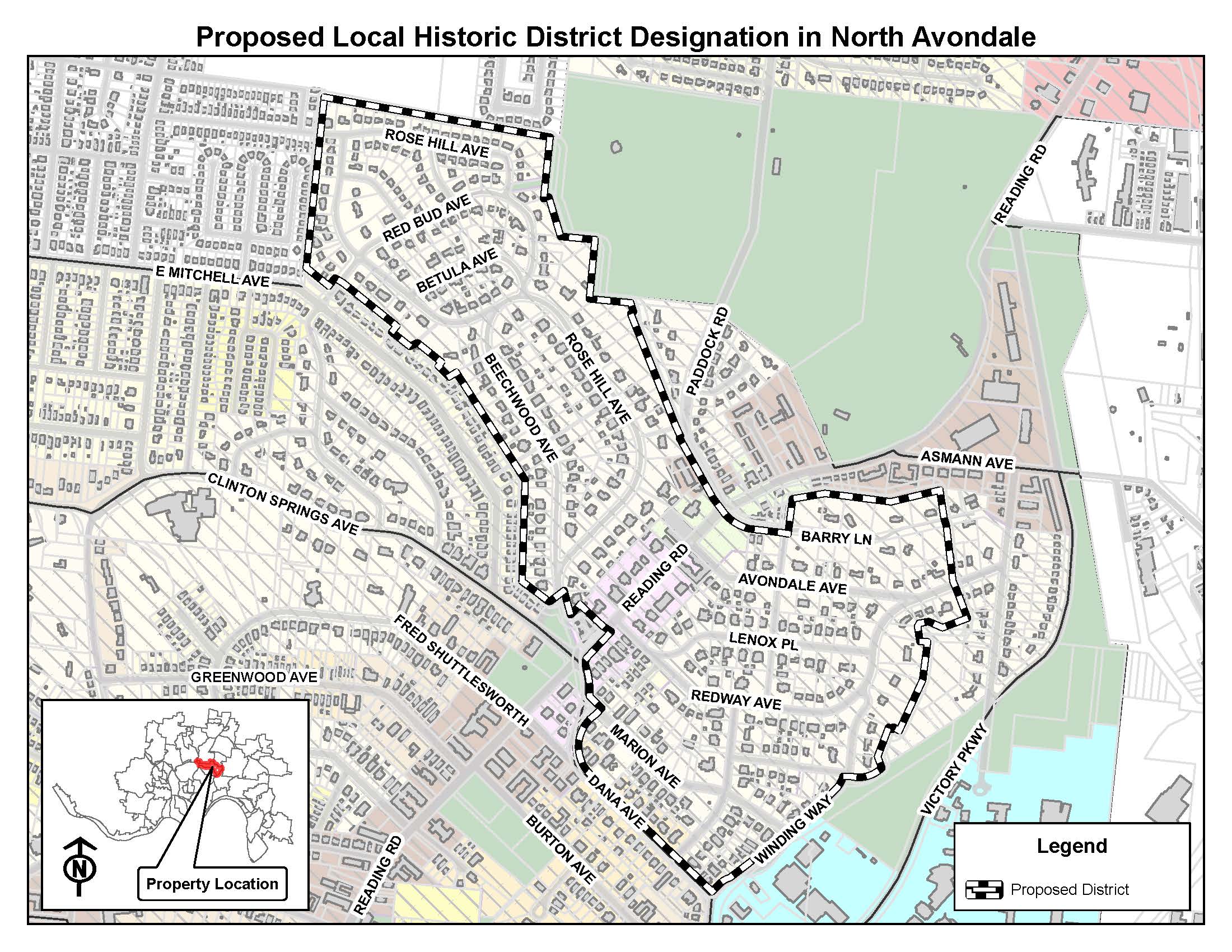
The North Avondale Neighborhood Association (NANA) and Vice Mayor Jan-Michele Kearney are proposing the designation of a local historic district in North Avondale, for the purpose of preserving the neighborhood’s historic resources and ensuring that new construction within the district is compatible with its historic character. Consultant Sullebarger Associates, in partnership with NANA, conducted research and prepared the designation report, proposed guidelines, and other application materials.
Proposed District
The North Avondale Historic District is significant in the history of Cincinnati as an upper middle-class residential neighborhood developed between 1896 and 1940. Development of North Avondale began in earnest in 1893 with the Rose Hill Park Subdivision, mostly on the west side of Reading Road, followed by other subdivisions on the east side. The force behind Rose Hill Park was Robert Mitchell, the wealthy owner of the Mitchell & Rammelsburg Furniture Company, who invested his profits in real estate. Buyers who built homes in the neighborhood included other captains of industry such as grocer Barney H. Kroger, clockmaker and jeweler Frank Herschede, and brewer Albert Lackman. As the neighborhood developed in the early twentieth century, North Avondale became an enclave for successful German Jews who moved there from the West End.
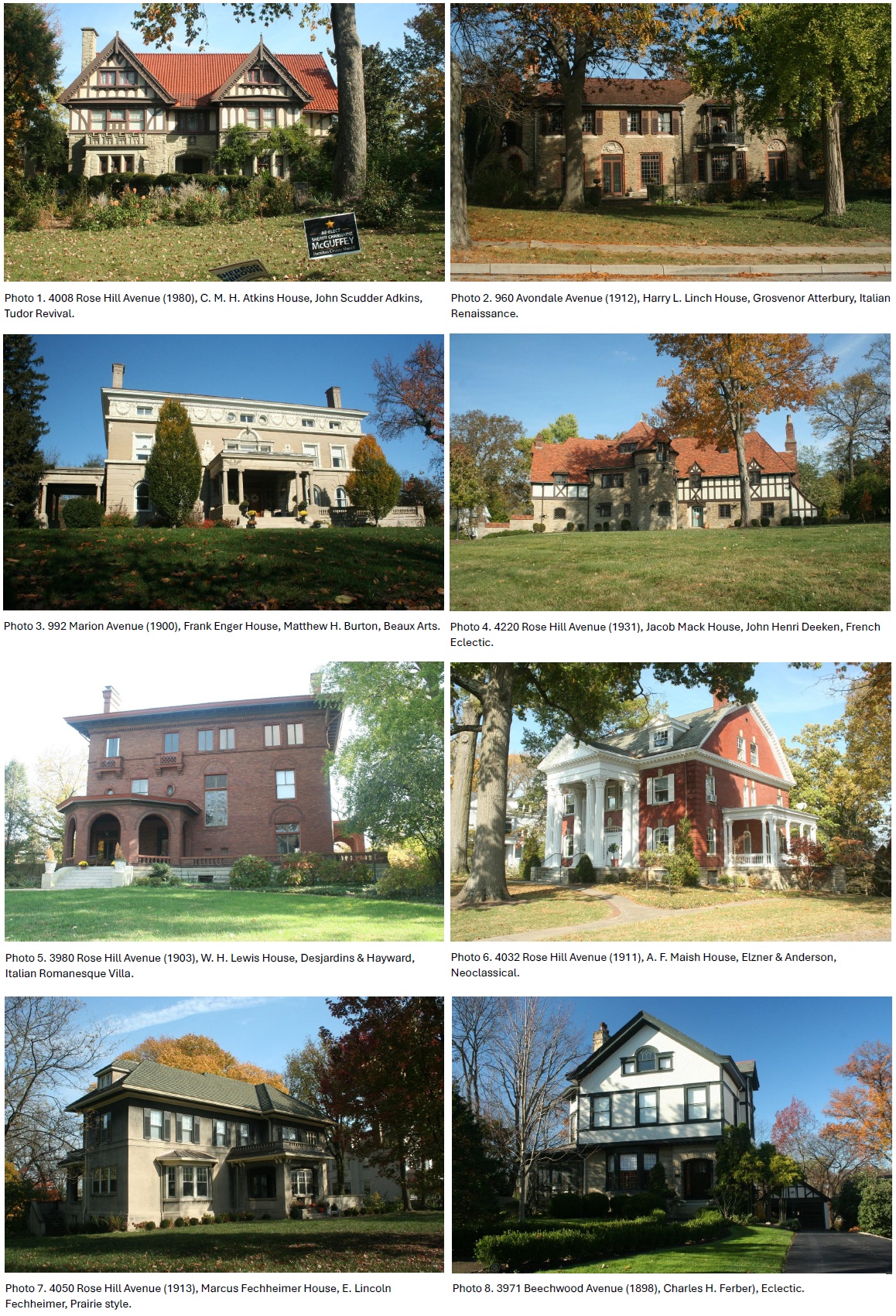
The North Avondale Historic District is architecturally significant as an example of the landscape-lawn approach to a suburban subdivision defined by a park-like character with continuous lawns and picturesque curving streets. Gaslights add to the historic ambiance. The district is also significant for the quality of its substantial high-style houses on large lots. Homes in North Avondale represent an unusually rich array of architectural styles (such as Queen Anne, Shingle, Richardsonian Romanesque, Italian Renaissance, Beaux Arts, Neoclassical, Chateauesque, French Eclectic, Swiss Chalet, Colonial Revival, Tudor Revival, Prairie, and Craftsman) that typify the period of significance. All of the contributing homes are individually distinctive, and many were designed by prominent local architects including John Scudder Adkins; Grosvenor Atterbury; Matthew H. Burton; John Henri Deeken; Desjardins & Hayward; Elzner & Anderson; A. Lincoln Fechheimer; Charles H. Ferber; S. S. Godley; Harry Hake; Samuel Hannaford & Sons; Anthony Kunz, Jr.; Harry Price; Herbert Spielman; and Tietig & Lee.
Example Structures
Below are a sample of typical structures that exemplify the characteristics of the district.
Upcoming Meetings
- Historic Conservation Board
Monday, March 9, 2026 at 3:00 PM
Held In Person
at 805 Central Avenue, Cincinnati, OH 45202,
Centennial II, Conference Room 508
Registration is not required. Written correspondence can be submitted to the contact listed below seven days in advance of the hearing. A livestream will be available here. - City Planning Commission
Friday, April 3, 2026 at 9:00 AM
Held In Person with a Virtual Option,
at 801 Plum St, Cincinnati OH, 45202
Council Chambers, Room 300
Registration is not required for in-person participation. Virtual participation requires advance registration no later than 48 hours in advance of the meeting. Participants should carefully review the public hearing instructions provided on our website here. Written comment can be submitted at any time to the contact listed below. A livestream will be available here. - Housing and Growth Committee
TBD
Past Meetings
- Public Staff Conference
January 27, 2026
Related Documents
Contact
For questions or assistance, please contact:
Gabrielle Couch, City Planner
gabrielle.couch@cincinnati-oh.gov | (513) 352-4882